
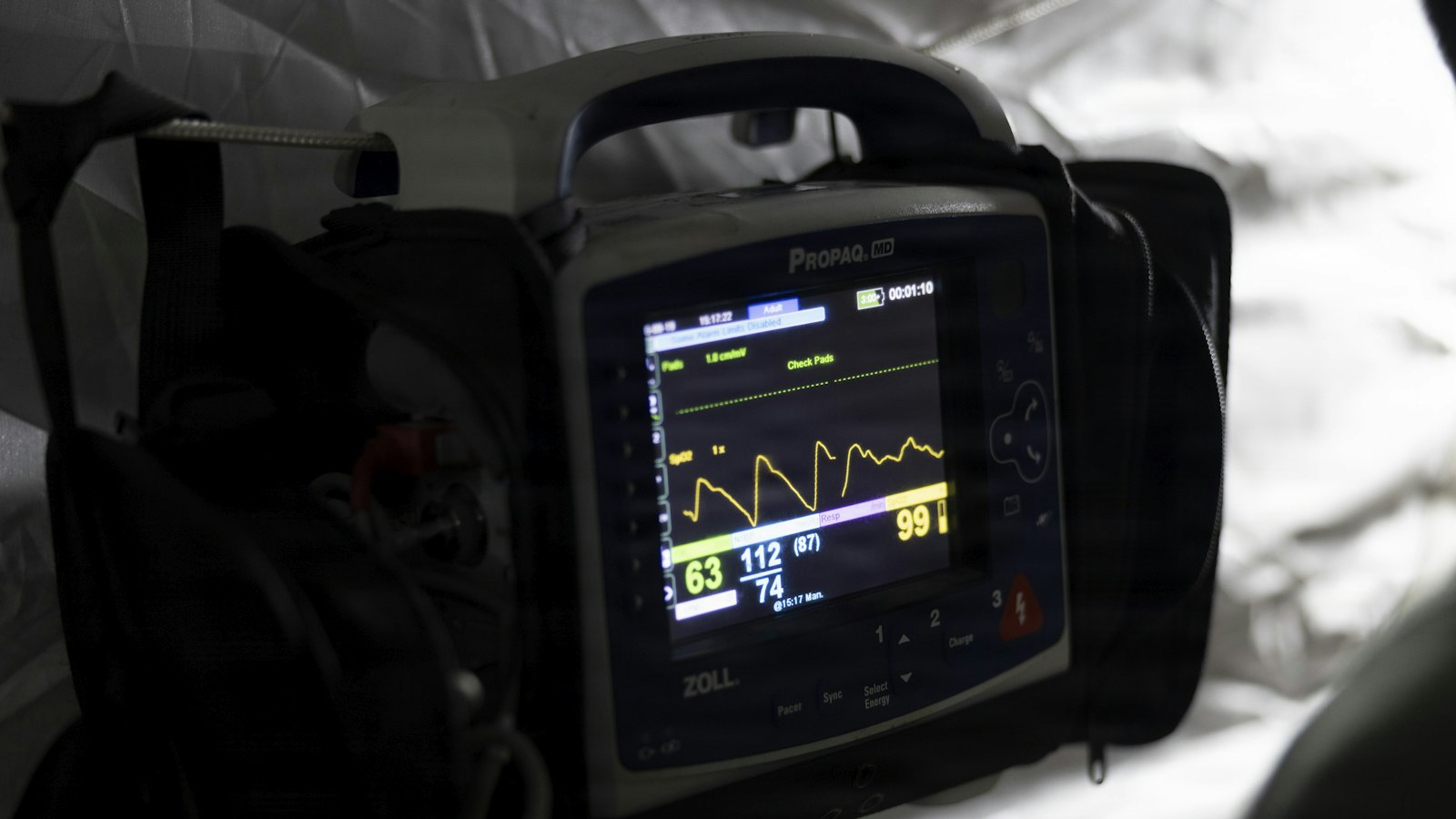
A monitor can display accurate physiologic data and still present an unacceptable clinical risk if its alarm system does not reliably attract attention, communicate urgency, or behave predictably under expected conditions. Patient monitor alarm testing evaluates that risk at the device level, producing objective evidence that alarm signals support essential performance and align with applicable regulatory requirements.
For manufacturers, the work is not limited to confirming that a speaker produces sound. Alarm verification must account for priority, acoustic characteristics, visual indication, alarm-state logic, operator controls, environmental conditions, and the interaction between the monitor and its accessories or networked functions. The resulting test record should be traceable to the intended use, risk management file, device specification, and applicable standard.
Why alarm performance requires dedicated verification
Clinical alarm fatigue is a known use and safety concern, but reducing nuisance alarms cannot come at the cost of missing or obscuring clinically significant conditions. Product teams must balance sensitivity, specificity, clarity, and operator workload. That balance is reflected in the design inputs and requires formal verification rather than an informal bench check.
For multi-parameter patient monitoring equipment, alarm behavior is commonly assessed in relation to IEC 60601-1-8, which addresses general requirements, tests, and guidance for alarm systems in medical electrical equipment and medical electrical systems. The applicable particular standard for the device type, such as IEC 60601-2-49 for multi-parameter patient monitoring equipment, may add or modify requirements. The current editions, jurisdictional adoption, device classification, and claimed functions should be confirmed before a protocol is finalized.
Alarm testing also supports the broader essential performance assessment. A device may need to generate an alarm when a measured value crosses a limit, when a technical fault occurs, when a sensor disconnects, or when communication is interrupted. Each condition can involve different detection logic, annunciation behavior, latching rules, reset behavior, and recovery expectations.
What patient monitor alarm testing evaluates
A defensible program begins with a clear alarm inventory. This inventory identifies physiological alarms, technical alarms, informational signals where applicable, and the conditions that initiate each one. It also defines the designated priority, associated visual indicator, audible signal, operator response, and expected behavior after the underlying condition resolves.
Audible alarm signals
Acoustic testing typically assesses whether alarm signals meet the required sound-pressure level and frequency-related characteristics at defined measurement locations and operating conditions. Test setup matters. Room acoustics, background noise, monitor orientation, microphone position, mains or battery operation, and other active sounds can affect results.
Priority differentiation is central to the evaluation. A high-priority alarm must be distinguishable from lower-priority alarms in a manner consistent with the applicable requirements. This may involve temporal patterns, pulse sequences, repetition rates, frequency components, and sound-pressure levels. Passing a minimum volume check alone does not demonstrate that priority signals are properly differentiated.
Manufacturers should also verify alarm volume controls. Where the user can adjust volume, the device must maintain required minimum performance at permitted settings and provide any required indication when volume is reduced or an audible alarm is paused. If alarm silence or pause functions are available, the test program should confirm their duration, indication, reactivation, and behavior when a new high-priority condition occurs.
Visual alarm indications
Visual alarm performance is evaluated alongside the audible signal. The review may include color, flashing behavior, location, visibility, priority presentation, and consistency across display modes. The purpose is to confirm that the operator receives an intelligible alarm indication, not simply a visible change on the screen.
Display configuration can complicate this assessment. Patient monitors may support split screens, external displays, central station connectivity, transport modes, dimming functions, or configurable layouts. If an alarm indicator can be obscured, minimized, or moved outside the operator’s normal field of view, that behavior needs to be evaluated against intended use and risk controls.
Alarm-condition logic and timing
Alarm annunciation depends on more than the output signal. The device must correctly identify the condition, apply configured thresholds and delays, assign the proper priority, and activate the required indicators within the specified response time. Testing therefore often uses controlled input simulation or patient simulator conditions to provoke alarm states reproducibly.
Typical verification scenarios include threshold violations, arrhythmia-related events when applicable, apnea detection, SpO2 limit alarms, invasive pressure alarms, lead-off conditions, sensor disconnections, battery-related conditions, and internal technical faults. The exact scenarios should derive from the monitor’s intended parameters and the product risk analysis. A monitor with ECG, NIBP, temperature, and SpO2 functions should not be tested as though every channel shares the same detection and alarm behavior.
Testing should also address return-to-normal behavior. Some alarms clear automatically when the condition resolves, while others may require acknowledgment or remain latched. Neither approach is universally correct. The expected behavior depends on the clinical significance of the event, the standard, the user interface design, and documented risk controls.
Building a protocol that supports a regulatory submission
The strongest patient monitor alarm testing protocols are developed from controlled design documentation, not from a generic test checklist. Inputs should include the alarm system specification, software requirements, user interface requirements, risk management documentation, labeling, intended use statement, and applicable standards matrix.
The protocol should define the equipment under test, software and hardware configuration, accessory configuration, test instrumentation, environmental conditions, acceptance criteria, sample handling, and data-recording method. It should state how simulated physiological inputs are established and how alarm response time is measured. Deviations must be documented, assessed, and resolved through the quality system.
Traceability is particularly valuable when multiple requirements converge. A single alarm feature may connect to a standard clause, a software requirement, a hazard control, a usability-related design input, and a verification record. Maintaining that connection reduces the risk of gaps during design review or regulatory submission preparation.
Laboratory selection also affects the usefulness of the final evidence. An ISO/IEC 17025-accredited laboratory can provide confidence that testing is performed under a controlled quality system, using calibrated instrumentation and documented methods within its accredited scope. For US market submissions, FDA ASCA program accreditation may be relevant when the laboratory and specific standard are within the program scope. Manufacturers should verify scope applicability rather than assuming that an accreditation applies to every device type or test method.
Common gaps that delay alarm verification
One recurring issue is testing only nominal settings. Monitors are frequently configurable, and the worst-case condition may occur at the lowest permitted alarm volume, a particular display brightness, battery operation, a specific parameter configuration, or an accessory combination. Worst-case selection should be justified and documented.
Another issue is treating simulated signals as sufficient for every claim. Simulation is often appropriate for controlled alarm-condition testing, but the chosen method must represent the relevant input behavior. For example, a sensor-disconnect alarm may require an accessory-specific setup, while a physiological limit alarm may be tested with a validated simulator. The test approach should match the function being verified.
Software updates are also a practical concern. A change to alarm logic, display behavior, signal library, connectivity function, or configuration management can affect previous evidence. Change impact assessment should identify whether regression testing is needed and which alarm scenarios must be repeated. A narrowly scoped change does not automatically mean a narrowly scoped risk.
Finally, human factors evidence and technical alarm testing serve different purposes. Acoustic and visual measurements demonstrate objective signal performance. Usability validation can demonstrate whether representative users recognize, interpret, and act on alarm-related information in realistic workflows. Depending on the device and intended users, both forms of evidence may be necessary.
Selecting meaningful test conditions
Alarm systems operate in clinical environments that are variable, noisy, and often workflow-intensive. Laboratory testing cannot reproduce every care setting, but it should represent the conditions required by the applicable standards and the device’s intended use. Manufacturers should avoid adding unsupported claims about alarm detectability in a particular hospital unit unless those conditions have been specifically evaluated.
The practical question is not whether an alarm is loud in isolation. It is whether the alarm system performs as specified, remains distinguishable by priority, communicates its condition through the intended user interface, and behaves consistently across validated operating states. That is the evidence reviewers and quality teams need to assess compliance and safety.
Sigma Scientific Services supports medical device manufacturers with standards-based safety and performance testing, including acoustic evaluations relevant to patient monitor alarm verification. Early protocol review can identify configuration gaps and worst-case conditions before formal testing begins, helping teams preserve schedule while maintaining defensible technical documentation.
When alarm performance is treated as a defined verification activity rather than a final-stage check, engineering and regulatory teams gain a clearer path from design requirements to objective evidence. That discipline helps ensure the monitor’s alarms communicate when clinical attention is needed most.
More insights
Consult with a medical device test expert
Tell us about your device and the standards you need. You’ll have a quote within 24 hours.
(305) 239-4441 info@sigmascientific.us 490 Sawgrass Corporate Parkway, Suite 130, Sunrise, FL 33325