A diagnostic ultrasound system can image well, clear basic functional checks, and still create regulatory risk if its output data is incomplete or poorly characterized. That is why acoustic output measurement medical devices remains a critical part of verification for manufacturers preparing for design validation, submissions, or product changes.
For ultrasound-based products, acoustic output is not a marketing specification. It is a safety and performance characteristic tied to exposure limits, labeling, device classification, and conformity to recognized standards. If the measurement approach is weak, the resulting problem is rarely limited to one test report. It can affect risk management files, technical documentation, and the credibility of the broader verification package.
Why acoustic output measurement matters in medical devices
Acoustic output measurement in medical devices supports two connected objectives. The first is patient safety. The second is demonstrating that the device performs within established limits and declared operating conditions. Both matter during product development, but they become especially important when data must stand up to regulatory review.
In practical terms, output measurements help characterize quantities such as acoustic power, pressure-related parameters, intensity, and exposure indices under defined operating modes. Those values are used to confirm whether a device remains within applicable limits and whether labeling and user information are technically justified. For diagnostic ultrasound, this can affect displayed indices, intended use statements, and the structure of supporting documentation.
There is also a timing issue that manufacturers often face. If acoustic testing is delayed until late verification or pre-submission, any discrepancy can force redesign, software adjustment, relabeling, or repetition of adjacent test activities. Early characterization is useful, but accredited final testing is what gives the data regulatory weight.
What acoustic output measurement medical devices testing typically includes
The exact test scope depends on device type, transducer configuration, operating modes, and the standards pathway being used. Even within diagnostic ultrasound, the work can vary significantly between general imaging, Doppler functions, specialized probes, and systems with application-specific presets.
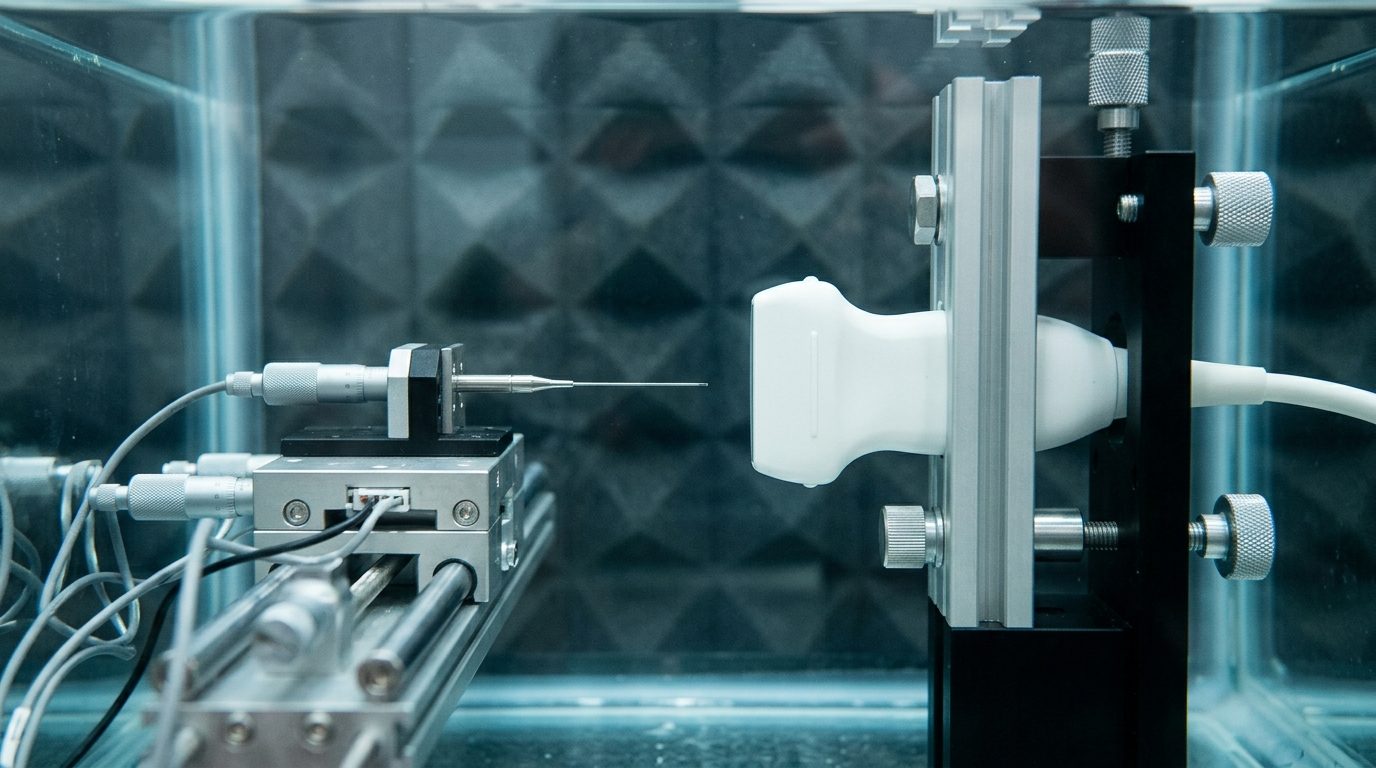
Most acoustic output measurement medical devices programs are designed to quantify output under controlled laboratory conditions using calibrated instrumentation and defined setups. This usually includes measurement of acoustic power and pressure-derived parameters, along with calculations or determinations needed to evaluate intensity-related outputs and relevant safety indices. Test conditions must be documented carefully because output can change with mode selection, beam settings, presets, loading conditions, and transducer architecture.
A common mistake is to treat acoustic output as a single-value specification. It is not. Output depends on how the device is configured and operated. The highest-risk condition may not be the default startup state, and the clinically relevant state may not be the maximum engineering setting. Good test planning identifies which operating conditions are both worst-case and representative for regulatory purposes.
Standards alignment is where the work becomes credible
For manufacturers, raw measurement data is only part of the deliverable. The more important question is whether the method, equipment, uncertainty treatment, and documentation align with the standards framework expected by regulators and notified reviewers.
That is where accredited laboratory execution matters. A2LA accreditation to ISO/IEC 17025 demonstrates that the laboratory operates under a recognized quality system for competence, calibration control, method validation, and reporting discipline. When testing is also performed within a framework relevant to FDA recognition programs, the output becomes more useful in submission strategy because the data is generated with regulatory expectations in mind.
This is especially important when acoustic output measurements are used to support declarations against recognized IEC or related consensus standards. If the report does not clearly define the method, test conditions, equipment traceability, and result interpretation, the manufacturer may still need to answer basic questions during review. A technically correct but poorly documented dataset can create avoidable back-and-forth.
The measurement process is more sensitive than many teams expect
Acoustic testing is affected by setup geometry, environmental control, alignment, fixture design, hydrophone positioning, water quality, and signal processing assumptions. Small errors in any of these can distort results enough to matter, particularly when a device is operating near a reporting threshold or design limit.
Transducer handling is another factor. Probe-to-probe variability, connector wear, surface condition, and thermal effects can influence measured output. For that reason, test planning should account for device state, sample selection, and conditioning requirements rather than assuming every unit is interchangeable.
Uncertainty analysis also deserves more attention than it sometimes gets. For compliance decisions, the measured value alone is not always sufficient. The uncertainty budget can affect how confidently a manufacturer can claim conformance to a limit, especially when margins are narrow. This becomes relevant during design transfer and when assessing whether a component, firmware, or manufacturing change has altered output enough to trigger additional validation.
When manufacturers usually need acoustic output testing
The need often appears at several points across the product lifecycle. During development, teams use output characterization to understand design behavior and identify settings that may require control. During formal verification and validation, they need standards-based evidence to support performance and safety claims. During regulatory submission, they need reporting that integrates cleanly with the rest of the technical file.
Post-market changes also trigger repeat work more often than expected. A transducer material change, beamforming update, software revision, power management change, or new preset can all affect acoustic output. Even if image quality looks unchanged, the exposure profile may shift. In those cases, the question is not simply whether the device still works. It is whether previously generated compliance evidence still applies.
This is where a specialized test partner adds value. Sigma Scientific Services supports manufacturers that need medically focused, standards-based acoustic and ultrasound testing with documentation suitable for compliance programs, product validation, and regulatory submission packages.
Common trade-offs in acoustic output measurement in medical devices
There is rarely a one-size-fits-all test strategy. A development team may want broad exploratory mapping across many modes, while a regulatory team may want a narrower, standards-driven protocol tied directly to submission requirements. Both approaches can be valid, but they serve different purposes.
Speed is another trade-off. Fast scheduling helps a program stay on track, but speed should not come at the expense of protocol clarity. If the scope is vague at the quoting stage, the lab may receive a device that is missing accessories, software configurations, or operating instructions needed to define worst-case testing. That usually creates delay later, not efficiency.
Manufacturers also need to decide how much evidence is enough for the specific regulatory objective. A limited data package may support internal comparison work, but formal compliance claims generally require a more controlled and fully documented approach. The cost difference is real, yet the cost of repeating testing after a reviewer question is often higher.
How to prepare for acoustic output measurement medical devices testing
The most efficient projects start with a clear definition of intended use, applicable standards, device configurations, and operating modes to be evaluated. Regulatory, engineering, and quality functions should align before samples are sent out. If those groups define the objective differently, the test plan tends to drift.
It also helps to provide complete device information upfront, including transducer variants, software versions, accessories, labeling, user manuals, and any internal rationale for worst-case selections. If there are known design constraints or prior output concerns, those should be disclosed early. Laboratories can plan around known issues more effectively than they can troubleshoot unexplained anomalies after the fact.
Manufacturers should also think beyond the final report. The underlying dataset may need to support risk analysis updates, engineering decisions, or responses to reviewer questions. That means the useful deliverable is not just a pass-fail statement. It is a technically defensible record of what was tested, how it was tested, and what the results mean in the context of the applicable standard.
Acoustic output testing is most valuable when it is treated as part of the device evidence package, not as an isolated checkpoint. When the method is standards-aligned, the setup is controlled, and the report is written for regulatory use, the data does more than satisfy a requirement. It reduces uncertainty at exactly the stage where uncertainty becomes expensive.
More insights
Consult with a medical device test expert
Tell us about your device and the standards you need. You’ll have a quote within 24 hours.
(305) 239-4441 info@sigmascientific.us 490 Sawgrass Corporate Parkway, Suite 130, Sunrise, FL 33325